Pages

Tuesday, June 26, 2012

The life of a MAVEN instrument lead

Jasper Halekas, SWIA instrument lead, University of California, Berkeley
While talking over a schedule issue with Dave Curtis (MAVEN Particles and Fields Package manager, and my immediate superior) the other day, I said to him, “I don’t know how you do it. It already feels like herding cats at my level. At your level it must feel like herding herds of cats.” As it turns out, I think that conversation pretty well sums up my role as an instrument lead. I’m at just the right level that I have to manage a pretty big herd of cats, but not so high that I have to manage multiple herds.

By the same token, I’m at a level at which I can actually focus on what is going on at the individual cat level, rather than having to manage at the herd level. The items I have to juggle to make a Solar Wind Ion Analyzer (SWIA) come together include mechanical and electrical design and testing, software and firmware, data processing and analysis, and of course, science. My team of talented cats engineers does all of the really hard work in the trenches, and the instrument couldn’t be built without their hard work and dedication. I hold the overall responsibility for producing an instrument that will do the best possible job of returning great science data from Mars, but I depend on the engineers to design, assemble, and test each of the components of the instrument with incredible care and precision.

To do my job right, I have to understand my instrument at a systems level, so that I know how these various components work together. This perspective helps me identify when an issue with one element may affect others, or when one seemingly small change in one place may ripple through the system and result in unforeseen consequences elsewhere. In practice, this means that I do a little bit of everything, including designing electrostatic optics for the sensor, writing specifications documents, talking over mechanical details with the engineers, poring over circuit board schematics and layouts looking for noise sources, writing procedures, carrying out tests, performing calibrations, and developing and debugging data analysis software. And of course, writing and responding to lots and lots and lots of e-mails. Did I mention that I am developing a touch of “E-mail Anxiety Disorder” on this project?

Jasper Halekas is the MAVEN instrument lead for the Solar Wind Ion Analyzer (SWIA) and an Assistant Research Physicist at the University of California Berkeley Space Sciences Laboratory. His current research focuses on solar wind interaction with the solid surface,  atmosphere/ exosphere, and crustal magnetic fields of the Moon and Mars. (Courtesy J. Halekas)
In addition to understanding my instrument and keeping track of the overall design, I have to be on the ball, on top of all of the activities happening on a day-to-day basis, and ready to immediately deal with the problems that inevitably crop up. Generally, dealing with a problem means some combination of testing to identify a cause, researching the issue, and talking to other scientists and engineers, in order to learn enough to make an informed decision as to the right path forward. Often, it means juggling schedules on a week-by-week, or sometimes a day-by-day level, to make sure that different parts of the instrument all come together at the right time. Sometimes, it means jumping into a gap and (for instance) helping write a procedure for applying conformal coating to an electronics board, or a rework/repair form. Other times, it means gowning up and heading into a clean room to test a circuit board that shows some unexpected behavior (carefully following planetary protection requirements, proper electrostatic discharge prevention protocol, etc.). All too often, it means writing and reviewing documents...and e-mails. (Did I mention the e-mails?)

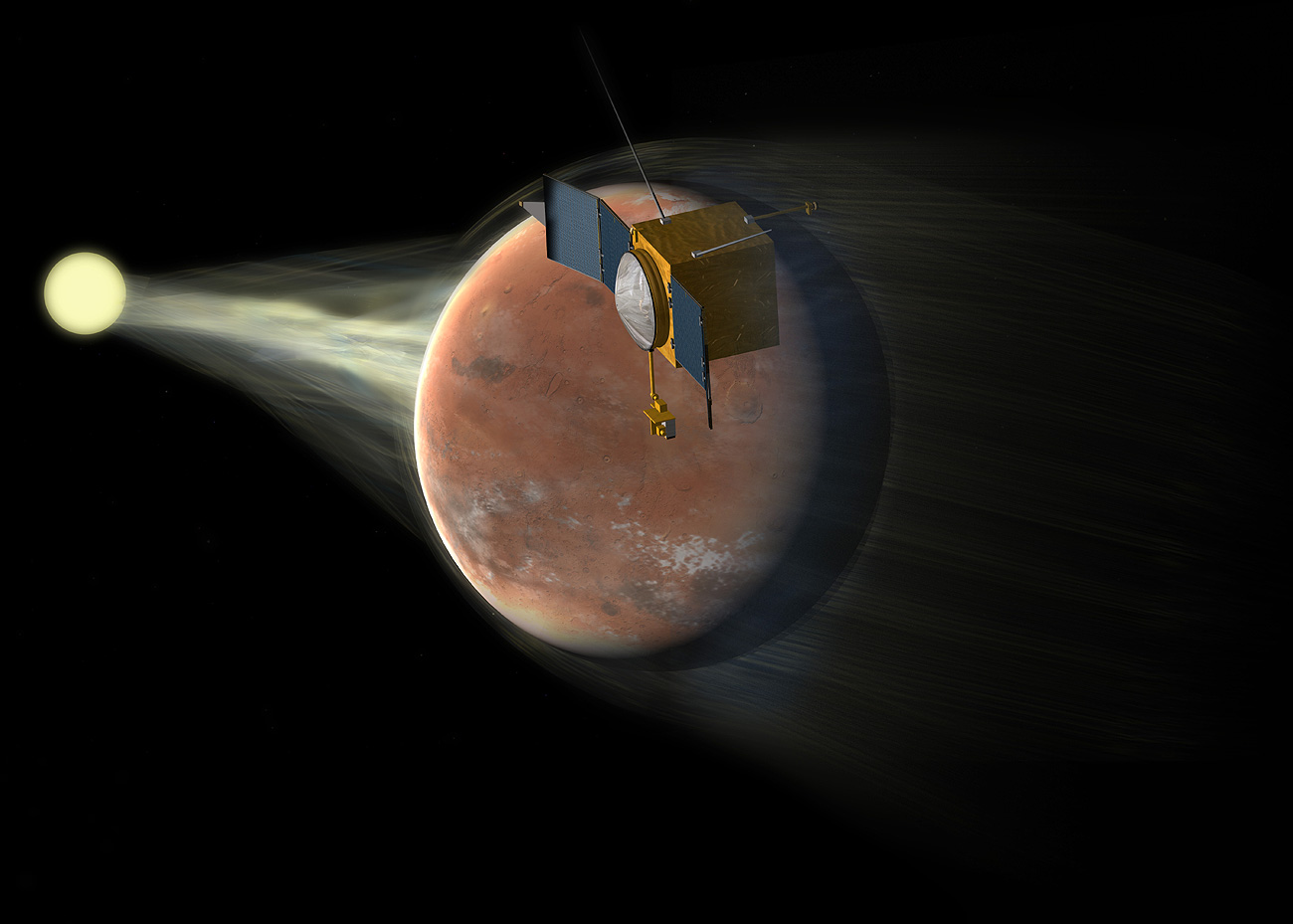
At the end of the day, though, it all comes back to making sure that my instrument is going to do great science. At Mars, my instrument needs to measure the solar wind energy input into the Martian atmosphere, in order to determine how the solar wind drives atmospheric escape to space. To produce an instrument that will do the best job of performing that task, we test, test, test, and test some more. First, we build engineering models of everything. Once we think we have a basic design that works, we test each flight component, test every flight electronics board, test every mechanism, perform Comprehensive Performance Tests on the integrated flight instrument, and calibrate the flight instrument with an ion source in vacuum to characterize the optics. We bombard the instrument with electromagnetic frequencies, measure its emissions, shake it really hard, and heat it up and cool it down to extremes past anything we expect to see in cruise or on orbit at Mars. Then we test it some more. When we break things—as we inevitably do—we fix them and make them better so they won’t ever break in flight.

It’s easy to forget how intrinsically cool my job is, as I’m herding cats, wading through stacks of documents, and attending endless meetings. But, I try to never completely lose sight of the fact that we’re building something that is ultimately going to fly to Mars and send back amazing data. It’s absolutely worth working really hard on that task and making sure it’s done right, even if I do have a few nightmares and develop some neuroses about my inbox along the way.

Thursday, May 31, 2012

MAVEN Profiles: Carlos Gomez-Rosa, MAVEN Systems Engineer

The second of a two-part Spanish-language series features MAVEN Systems Engineer Carlos Gomez-Rosa. The newly released video was produced by the Scientific Visualization Studio at NASA’s Goddard Space Flight Center and is subtitled in English. Gomez-Rosa discusses his work on the ground communication system for the MAVEN mission and his experience at Goddard. The series aims to make MAVEN more accessible to Spanish-speaking communities and compliments the MAVEN Red Planet: Read, Write, Explore! program, an educational project with a Spanish focus. The video may be particularly useful during Red Planet teacher training workshops, which target English as a Second Language, Spanish as a Second Language, and bilingual educators. For more information about MAVEN Red Planet, please visit: http://lasp.colorado.edu/home/maven/education-outreach/for-educators/red-planet/.

Tuesday, May 29, 2012

MAVEN Profiles: Sandra Cauffman, MAVEN Deputy Project Manager

A newly released NASA video features MAVEN Deputy Project Manager Sandra Cauffman speaking in Spanish about her work on the mission. Released today with English subtitles, the video highlights Cauffman’s career at the NASA Goddard Space Flight Center and details her integral role in coordinating the MAVEN budget and schedule. The video is the first in a two-part Spanish-language series that aims to make MAVEN more accessible to Spanish-speaking communities. The video compliments the MAVEN Red Planet: Read, Write, Explore! program, an educational project with a Spanish focus. The video may be particularly useful during Red Planet teacher training workshops, which target English as a Second Language, Spanish as a Second Language, and bilingual educators. For more information about MAVEN Red Planet, please visit: http://lasp.colorado.edu/home/maven/education-outreach/for-educators/red-planet/.

Wednesday, April 11, 2012

MAVEN Science Community Workshop – Dec. 2, 2012

MAVEN Science Community Workshop
December 2, 2012
Location — downtown San Francisco (venue to be determined)
We are planning a one-day workshop for the Mars science community to discuss the MAVEN mission. We will provide details on the mission plan, spacecraft, instruments, observations and sequencing, and anticipated data products and science return. We want to make detailed information available so that those scientists with an interest in using the data or applying it to models can begin preparing for data return and release, and so that those with an interest in proposing for the planned Participating Scientist program can learn details of what we are planning.

The workshop will be held on the Sunday immediately before the Fall AGU meeting (note that the dates for the AGU meeting have been changed to 3-7 December). It will be somewhere in the downtown San Francisco vicinity in order to make it easy for the participants, at a venue still to be determined.

Details will be posted on this web site as they solidify. Please email Kathleen Cirbo if you would like to be on the mailing list for receiving further information.

Wednesday, March 14, 2012

Latest MAVEN Science Update

View the latest MAVEN science update in this (PDF) presentation from MAVEN PI Bruce Jakosky, Project Scientist Joe Grebowsky, and Project Manager David Mitchell. The presentation was given at the 2012 Mars Exploration Program Analysis Group meeting in Washington, DC.
http://lasp.colorado.edu/home/maven/files/2012/03/MAVEN_MEPAG-2012.pdf

Tuesday, February 28, 2012

A stressful test

As I stood watching the static loads test of the MAVEN spacecraft structure, my thoughts went back to my high school physics class, where we built bridges out of balsa wood. To see which bridge was the strongest, the teacher applied a force to the center until the bridge broke. Each student would cringe as the pressure increased, waiting for the sound of splintering wood. I had that same feeling now.
To continue reading this post, visit the MAVEN website: A stressful test

Wednesday, September 28, 2011

MAVEN Core Structure Complete

NASA’s Mars Atmosphere and Volatile EvolutioN (MAVEN) mission has reached a new milestone. Lockheed Martin has completed building the primary structure of the MAVEN spacecraft at its Space Systems Company facility near Denver. The MAVEN spacecraft is scheduled to launch in November 2013 and will be the first mission devoted to understanding the Martian upper atmosphere.


To read the full news release, visit:
MAVEN Mission Primary Core Structure has been completed at Lockheed Martin