Pages

Thursday, October 25, 2012

Preparing for Science Data

Dave Brain, MAVEN Science Team Co-Investigator 

Teamwork.

The success of MAVEN hinges almost entirely on teamwork. As a scientist that uses data returned by spacecraft, it is sometimes easy for me to forget the number of people involved in making it possible for those squiggly lines of data to dance across my computer screen. After all, I simply need to load the data into my analysis software, make a plot, and learn something new about the planet I am studying (Ha! I laughed out loud as I wrote this because it is never this simple). I love doing this—a few times a year, as I look at my screen, I realize that I am the only person on the face of the Earth that has some new tidbit of information. The ‘A-ha!’ moment is an incredible rush, as is the period where I get to share the result with others.

Being involved in MAVEN has reminded me that science efforts are never independent. Thousands of people are working to make MAVEN successful. The instrument teams are testing and tweaking their instruments in preparation for delivery over the next few months to Lockheed Martin, where they will be incorporated onto the spacecraft. The spacecraft team has been working hard to get the many necessary components (electrical systems, communication systems, reaction wheels, etc.) onto the spacecraft, and preparing to receive the science instruments. I am in constant awe of the way in which these teams handle incredibly complex tasks and make them seem simple.

But what is the science team doing? After all don’t we need the data before we can do our work?

Dr. Dave Brain is a Co-Investigator on the MAVEN science team and serves as a science advisor for the Invisible Mars: Science on a Sphere education and outreach project. Dr. Brain is an assistant professor at the University of Colorado Boulder in the Laboratory for Atmospheric and Space Physics and the Department of Astrophysical and Planetary Sciences. (Courtesy Allison Baker)

The science team has not been sitting idle. We are getting ready to use MAVEN data in a variety of ways. But working with spacecraft measurements is not always a straightforward endeavor. An enormous amount of a scientist’s time can be wasted on dealing with unorganized or unnecessarily complicated datasets. More time is left for making new discoveries when data are made easy to acquire and work with. MAVEN faces a particular challenge because data from all its instruments must be considered together in order to answer our main science questions (even the instruments need to work as a team!). But the datasets are fundamentally different. For example, some instruments make measurements at the location of the spacecraft, while others look at the atmosphere far from the spacecraft. These different datasets must all be well organized, and fit together in a way that the science team can easily get to their ‘A-ha!’ moments.

My job right now is to lead an effort to make tools for the science team that solve these challenges. For the past year we have been devising plans for tools that facilitate ‘Intercomparison and Visualization’ of MAVEN data. Over the next few months we will begin developing a web portal to the MAVEN data that will allow MAVEN scientists to view and obtain the spacecraft viewing geometry, data availability, and actual measurements in a variety of different ways. Users will be able to interact directly in the webpage with many of the plots, making our site a ‘first of its kind’ experience. In addition, we are building a ‘toolbox’ of especially useful software routines that can be used with MAVEN data, thus saving the individual scientists precious time developing their own routines. Importantly, both the web page and the software toolbox are tailored to using data from different instruments simultaneously.

Now that we have the tools designed, I’m excited to see them become reality over the coming months as developers and science team members collaborate on specific features and functionality. I am confident that we’re going to provide tools that make the scientist’s analysis tasks easier.

But it’s going to take teamwork.

Friday, September 14, 2012

MAVEN: Mars Atmospheric Loss

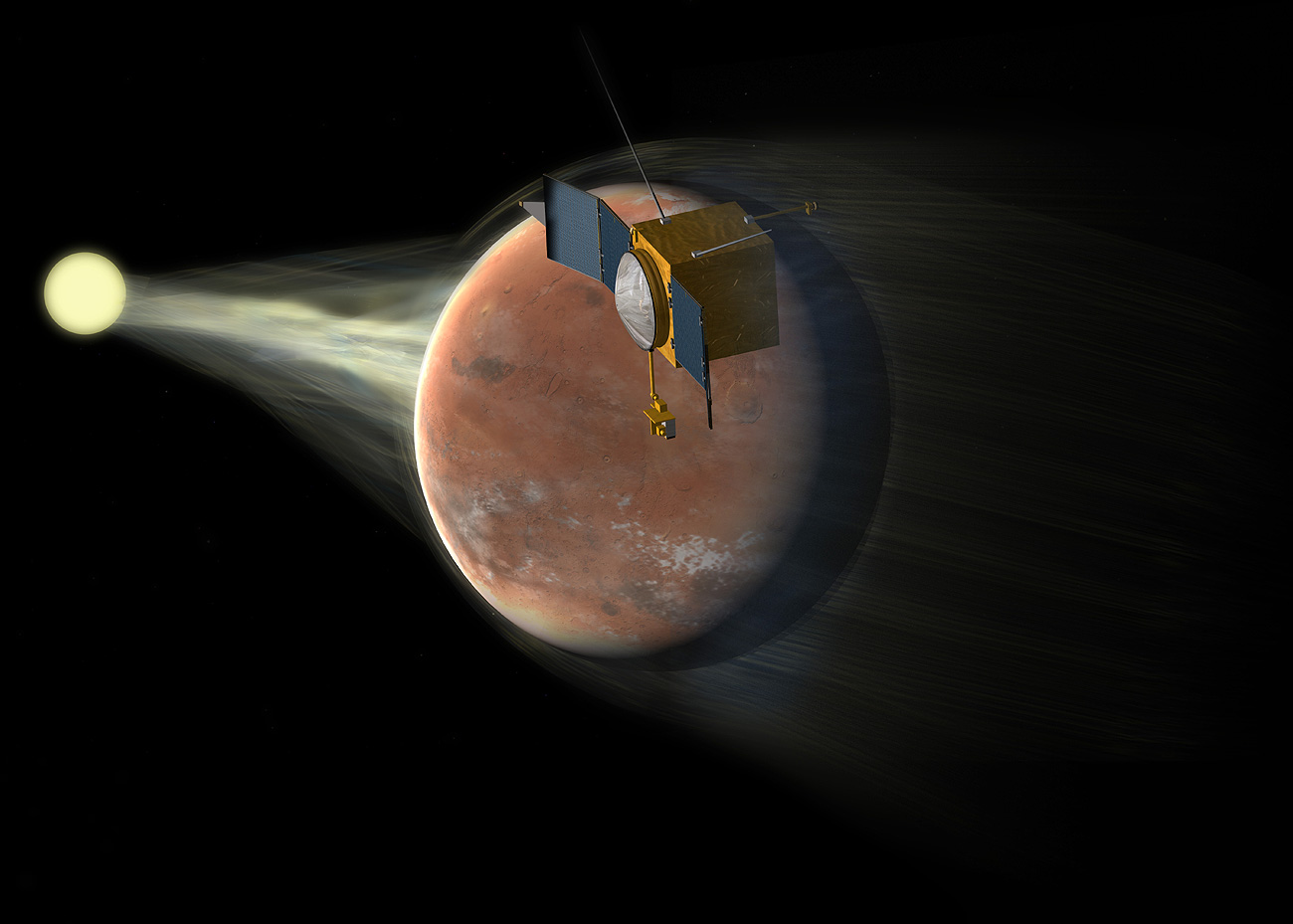
When you take a look at Mars, you probably wouldn't think that it looks like a nice place to live. It's dry, it's dusty, and there's practically no atmosphere. But some scientists think that Mars may have once looked like a much nicer place to live, with a thicker atmosphere, cloudy skies, and possibly even liquid water flowing over the surface. So how do you go from something like this--to something like this? NASA's MAVEN spacecraft will give us a clearer idea of how Mars lost its atmosphere, and scientists think that several processes have had an impact.

One way a planet can lose its atmosphere is through a process called "sputtering." In this process, atoms are knocked away from the atmosphere due to impacts from energetic particles. Watch this brief video to learn more:


Friday, August 31, 2012

The MAVEN Science Data Center

by Alex DeWolfe, MAVEN Science Data Center Manager

Alex DeWolfe is the MAVEN Science Data Center Manager at the University of Colorado's Laboratory for Atmospheric and Space Physics. (Courtesy Alex DeWolfe) 


 I’m in charge of the Science Data Center (SDC) for MAVEN, part of the Science Operations Center at LASP. Our job is to store all of the science data produced during the mission in one place and make it easily accessible to all of the members of the science team, to generate preliminary plots of science data, and to make sure all of the science data is archived for future use and public access.

 The SDC is part of the MAVEN “ground system,” the network of institutions, people, computers, and antennas here on Earth that communicates with the spacecraft, controlling it and handling all the data it sends back. Once the spacecraft goes into orbit around Mars in 2014, after all the instruments have been checked out and we know everything is working smoothly, we’ll start collecting science data and beaming it back to Earth. We’re going to a lot of trouble to build a spacecraft and send it to Mars, and the science data is the point of the whole mission! An important aspect of MAVEN science is that we plan to use science data from all the instruments together to get the most complete picture of the atmosphere possible. In order to do that, we have to have all of the data available to the entire team simultaneously. The MAVEN team is made up of a lot of people at different places around the U.S. and the world, and we need to have a central library of data where all of the team members can get the latest data products.

You might think that the bits come back from the spacecraft and go straight to the scientists, or that everything is processed in one central location. In reality, what the spacecraft sends us is a very low-level form of data that has to be refined before it’s usable by the science team. First, the “telemetry,” the stream of bits coming from the spacecraft, is collected by the Deep Space Network (DSN), using their worldwide network of huge radio antennas. The DSN hands the data off to the Mission Support Area at Lockheed Martin, which is responsible for spacecraft operations. They send the science and instrument data to us at the Science Operations Center, where we process the telemetry into a slightly more usable form.

The MAVEN Science Data Center is part of the Science Operations Center at LASP, where MAVEN science data will be stored, accessed by the science team to generate preliminary plots of science data, and archived for future use and public access. (Courtesy LASP) 


 The Payload Operations side of our group manages the instrument operations, making sure the instruments are working properly and planning upcoming observations. Meanwhile, the science data and a little bit of spacecraft data go into the storage system here at the SDC. We do some processing to generate “quick-look” plots, to give the science team a first look at the science data from the past few days, and then we make sure that all the data the team needs for more advanced processing is present and accounted for. We have to keep the data safe—we can’t have losses from hard drive crashes or power failures—but we also have to get it to the rest of the team as soon as possible.

After the rest of the team gets their hands on the data they need, they then turn it into real “science products.” These are mostly data files, which they can use to examine and compare various quantities that we’re measuring at Mars. These files are delivered back to the SDC, where we can keep them safe and share them with the rest of the team. After the first few months of the mission, we’ll come to another SDC task: sending the science data to the Planetary Data System, where it is permanently archived and made available to the wider scientific community.

I joined the MAVEN team as we were just starting to design the SDC systems, and now we’re starting to set up hardware and write software. It’s been fun so far, but I’m really looking forward to the next few years, in which we’ll put together the whole SDC and start operating it as MAVEN arrives at Mars. I feel tremendously fortunate to be part of this exciting mission.

Tuesday, June 26, 2012

The life of a MAVEN instrument lead

Jasper Halekas, SWIA instrument lead, University of California, Berkeley
While talking over a schedule issue with Dave Curtis (MAVEN Particles and Fields Package manager, and my immediate superior) the other day, I said to him, “I don’t know how you do it. It already feels like herding cats at my level. At your level it must feel like herding herds of cats.” As it turns out, I think that conversation pretty well sums up my role as an instrument lead. I’m at just the right level that I have to manage a pretty big herd of cats, but not so high that I have to manage multiple herds.

By the same token, I’m at a level at which I can actually focus on what is going on at the individual cat level, rather than having to manage at the herd level. The items I have to juggle to make a Solar Wind Ion Analyzer (SWIA) come together include mechanical and electrical design and testing, software and firmware, data processing and analysis, and of course, science. My team of talented cats engineers does all of the really hard work in the trenches, and the instrument couldn’t be built without their hard work and dedication. I hold the overall responsibility for producing an instrument that will do the best possible job of returning great science data from Mars, but I depend on the engineers to design, assemble, and test each of the components of the instrument with incredible care and precision.

To do my job right, I have to understand my instrument at a systems level, so that I know how these various components work together. This perspective helps me identify when an issue with one element may affect others, or when one seemingly small change in one place may ripple through the system and result in unforeseen consequences elsewhere. In practice, this means that I do a little bit of everything, including designing electrostatic optics for the sensor, writing specifications documents, talking over mechanical details with the engineers, poring over circuit board schematics and layouts looking for noise sources, writing procedures, carrying out tests, performing calibrations, and developing and debugging data analysis software. And of course, writing and responding to lots and lots and lots of e-mails. Did I mention that I am developing a touch of “E-mail Anxiety Disorder” on this project?

Jasper Halekas is the MAVEN instrument lead for the Solar Wind Ion Analyzer (SWIA) and an Assistant Research Physicist at the University of California Berkeley Space Sciences Laboratory. His current research focuses on solar wind interaction with the solid surface,  atmosphere/ exosphere, and crustal magnetic fields of the Moon and Mars. (Courtesy J. Halekas)
In addition to understanding my instrument and keeping track of the overall design, I have to be on the ball, on top of all of the activities happening on a day-to-day basis, and ready to immediately deal with the problems that inevitably crop up. Generally, dealing with a problem means some combination of testing to identify a cause, researching the issue, and talking to other scientists and engineers, in order to learn enough to make an informed decision as to the right path forward. Often, it means juggling schedules on a week-by-week, or sometimes a day-by-day level, to make sure that different parts of the instrument all come together at the right time. Sometimes, it means jumping into a gap and (for instance) helping write a procedure for applying conformal coating to an electronics board, or a rework/repair form. Other times, it means gowning up and heading into a clean room to test a circuit board that shows some unexpected behavior (carefully following planetary protection requirements, proper electrostatic discharge prevention protocol, etc.). All too often, it means writing and reviewing documents...and e-mails. (Did I mention the e-mails?)

At the end of the day, though, it all comes back to making sure that my instrument is going to do great science. At Mars, my instrument needs to measure the solar wind energy input into the Martian atmosphere, in order to determine how the solar wind drives atmospheric escape to space. To produce an instrument that will do the best job of performing that task, we test, test, test, and test some more. First, we build engineering models of everything. Once we think we have a basic design that works, we test each flight component, test every flight electronics board, test every mechanism, perform Comprehensive Performance Tests on the integrated flight instrument, and calibrate the flight instrument with an ion source in vacuum to characterize the optics. We bombard the instrument with electromagnetic frequencies, measure its emissions, shake it really hard, and heat it up and cool it down to extremes past anything we expect to see in cruise or on orbit at Mars. Then we test it some more. When we break things—as we inevitably do—we fix them and make them better so they won’t ever break in flight.

It’s easy to forget how intrinsically cool my job is, as I’m herding cats, wading through stacks of documents, and attending endless meetings. But, I try to never completely lose sight of the fact that we’re building something that is ultimately going to fly to Mars and send back amazing data. It’s absolutely worth working really hard on that task and making sure it’s done right, even if I do have a few nightmares and develop some neuroses about my inbox along the way.

Thursday, May 31, 2012

MAVEN Profiles: Carlos Gomez-Rosa, MAVEN Systems Engineer

The second of a two-part Spanish-language series features MAVEN Systems Engineer Carlos Gomez-Rosa. The newly released video was produced by the Scientific Visualization Studio at NASA’s Goddard Space Flight Center and is subtitled in English. Gomez-Rosa discusses his work on the ground communication system for the MAVEN mission and his experience at Goddard. The series aims to make MAVEN more accessible to Spanish-speaking communities and compliments the MAVEN Red Planet: Read, Write, Explore! program, an educational project with a Spanish focus. The video may be particularly useful during Red Planet teacher training workshops, which target English as a Second Language, Spanish as a Second Language, and bilingual educators. For more information about MAVEN Red Planet, please visit: http://lasp.colorado.edu/home/maven/education-outreach/for-educators/red-planet/.

Tuesday, May 29, 2012

MAVEN Profiles: Sandra Cauffman, MAVEN Deputy Project Manager

A newly released NASA video features MAVEN Deputy Project Manager Sandra Cauffman speaking in Spanish about her work on the mission. Released today with English subtitles, the video highlights Cauffman’s career at the NASA Goddard Space Flight Center and details her integral role in coordinating the MAVEN budget and schedule. The video is the first in a two-part Spanish-language series that aims to make MAVEN more accessible to Spanish-speaking communities. The video compliments the MAVEN Red Planet: Read, Write, Explore! program, an educational project with a Spanish focus. The video may be particularly useful during Red Planet teacher training workshops, which target English as a Second Language, Spanish as a Second Language, and bilingual educators. For more information about MAVEN Red Planet, please visit: http://lasp.colorado.edu/home/maven/education-outreach/for-educators/red-planet/.

Wednesday, April 11, 2012

MAVEN Science Community Workshop – Dec. 2, 2012

MAVEN Science Community Workshop
December 2, 2012
Location — downtown San Francisco (venue to be determined)
We are planning a one-day workshop for the Mars science community to discuss the MAVEN mission. We will provide details on the mission plan, spacecraft, instruments, observations and sequencing, and anticipated data products and science return. We want to make detailed information available so that those scientists with an interest in using the data or applying it to models can begin preparing for data return and release, and so that those with an interest in proposing for the planned Participating Scientist program can learn details of what we are planning.

The workshop will be held on the Sunday immediately before the Fall AGU meeting (note that the dates for the AGU meeting have been changed to 3-7 December). It will be somewhere in the downtown San Francisco vicinity in order to make it easy for the participants, at a venue still to be determined.

Details will be posted on this web site as they solidify. Please email Kathleen Cirbo if you would like to be on the mailing list for receiving further information.